
- By Pyae Thet Phyo and Lun Min Mang / Myanmar Times | May 29, 2017
The government and ethnic armed groups have failed to reach an agreement on the issues of secession and self-determination in the final day of the second round of the 21st-Century Panglong Conference.
But all the parties agreed to continue the discussion on the issues of non-secession and self-determination during the next round of talks, which has yet to be scheduled
The second round of 21st-Century Panglong Conference is concluding today. Government, political parties and eight signatory groups discussed on the 41 points prepared in advance by the Union Political Dialogue Joint Committee (UPDJC).
Participants yesterday reached agreement on 33 points of total 41 points, which are going to be signed by leaders of government, Tatmadaw, signatory groups and political parties as part of the “Union Peace Accord” today (May 29).
There were 20 points in the political sector discussion of which 12 were agreed and 8 were left for further negotiation.
Except the sectors of politics and security, conference’s representatives agreed on all points in the rest sectors. Security sector’s policy debates are excluded for negotiation between government (including Tatmadaw) and signatory armed groups.
The term “non-secession” remains the most debated issue in the political debates among the participants during the six-day peace forum, which is ruling National League for Democracy’s policy priority since it took office in April of 2016.
During the debates in the political sectors, the government (includingTatmadaw ) had disagreements with ethnic politicians and armed groups reps on the term “non-secession”.
The ethnic representatives in the panel discussion of politics say the term “non-secession” reflects distrust of one side to the other, which could be an obstacle in trust-building.
Shan Nationalities League for Democracy (SNLD) released last week a statement while its members were attending the conference has called for the use of “more positive” words than “non-secession”.
Instead of building a federal union based on “doubts”, mutual-understanding, respect and trust should be the foundation of the process, it said in its statement released on May 25.
In the succeeding meetings, the participants of the political debate forum went on arguing about the usage of the term, but after knowing that an agreement would not be reached, the UPDJC, a tripartite body of government, political parties and armed signatory groups to Nationwide Ceasefire Agreement (NCA) authorised for holding peace dialogues, has decided to leave the two issues to be discussed at next conference.
The State Counsellor office’s director general U Zaw Htay told reporters on May 28 that both sides still have to reconcile the diverse perspectives on the “non-secession” policy that were, if agreed by parties, going to be one of the basic principles for future federal building.
“If they do not agree to include the policy of “non-secession” from the union, we have to ask the question – are they willing to secede?” he said.
According U Zaw Htay, accepting the principle of “non-secession” from the union was a bargaining point of government (and Tatmadaw), of which disagreement led to the leaving of another issue of “self-determination” to be discussed at next conference.
UPDJC in May before the start of the 21st-Century Panglong Conference, agreed to put “self-determination” as one of the principles to be debated at the union-level peace talk. It is allowing the states and regions to draw their own version of constitution, which must not, however, go beyond the Union’s constitutional boundary.
Ethnic representatives’ insistence not to use the word “non-secession” as this makes them feel untrustworthy was deemed by government (and Tatmadaw) as a risk because self-determination was also on the debate-table.
U Zaw Htay said the two issues are linked; self-determination would come only after the ethnic representatives agreed on the principle of “non-secession” from the union.
“Some ethnic armed groups could not promise on this (not to secede from the union). We cannot continue dialogues on other issues such as self-determination unless they are committed to agree on ‘non-secession’ principle,” he said.
Leaving eight points to be discussed at the next conference, the political forum in the 21st-Century Panglong Conference could agree on only 12 points.
Participants also discussed in different forums social, economy, security, land and environment issues.
Northern groups’ first time meeting with State Counsellor
Though expressed as ‘more social’ rather than ‘political’, the meeting of Wa-led new committee with State Counsellor Daw Aung San Suu Kyi who also chairs the National Reconciliation and Peace Centre, government’s peace secretariat, was considered an important step in the ongoing peace process.
Among the groups who met with Daw Aung San Suu Kyi were representatives from the three excluded groups – Myanmar National Democratic Alliance Army (Kokang), Ta’ang National Liberation Army (TNLA) and Arakan Army by the former administration to have peace negotiation or sign the NCA.
The three groups together with some factions of Kachin Independence Army, formed Northern Alliance and launched coordinated offensives against military targets of government and civilian infrastructure in November of 2016, causing disruption of border-trade between China and Myanmar.
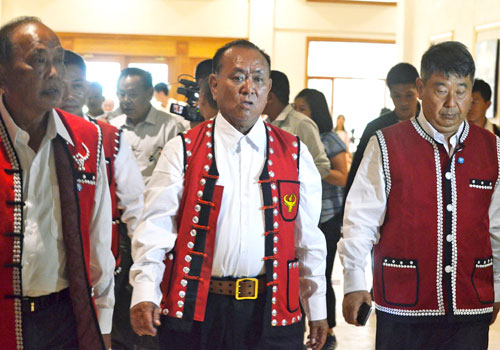
The committee formed in late February and led by United Wa State Army, the self-proclaimed “Federal Political Negotiation and Consultative Committee” also includes KIA, National Democratic Alliance Army (NDAA aka Mongla), Shan State Progressive Party (SSPP). It has called for replacement of NCA with a more justified peace treaty.
Despite having heard the straightforward speech of Commander-in-Chief of Defense Services Senior General Min Aung Hlaing at the opening ceremony on May 24 that the army will not accept alternative way to NCA for peace, members of the FPNCC insisted that they will not sign the NCA because it could not end fighting aftermath the signing. Instead,they said they would seek alternative way.
U Zaw Htay also said NCA cannot be amended, but the political dialogue framework can be compromised with the armed ethnic groups.
The committee also handed to the State Counsellor their proposal for peace negotiation with the government.
In a booklet distributed by the committee before they meet, it said there were initial efforts to amend the NCA between the UWSA and Tatmadaw. The efforts however failed after a summit of ethnic groups in Wa’s stronghold capital of Pangkham in April. It did not elaborate why the efforts failed.
“The NCA that she said and what we said are not the same. We are going to sign only the ceasefire agreement that we have amended,” Zhao Guo An, head of UWSA’s foreign affairs department told reporters after meeting with the State Counsellor.
China has played an important role in negotiating with government and Tatmadaw to allow the Northern Alliance members to appear at the opening ceremony of 21st-Century Panglong Conference.
Sun Guoxiang, special envoy on Asian Affairs of Chinese foreign affairs ministry met with senior general Min AungHlaing and State Counsellor Daw Aung San Suu Kyi on May 23, just one day before the conference kicked off. How the Chinese diplomat negotiated has not yet been revealed.
This article was originally published on Myanmar Times on May 29, 2017.